
Totem Tour Trail – Duncan
The City of Duncan on Vancouver Island, is the best place to see totem poles in British Columbia. Back in 1985, the Mayor, Douglas Barker, started a project to fill the city with totem poles. The idea was to celebrate the close ties between the City of Duncan and the local Quw’utsun Nation, and to honor the art form of totem poles and their cultural significance. In 1986 the city was designated “City of Totems.” It now has the largest outdoor collection of public displayed totem poles in the world, with over 40 totem poles.
There is an official Totem Tour walk that allows visitors to easily explore this charming city and get up close to these traditional works of art. I LOVED seeing these totems and learning about their stories. I deliberately did not post all of them, so you’ll need to visit to see the whole set.

Duncan Totem tour – the basics
Distance: Less than 2km
Elevation Gain: None.
Time: 30 mins- 1 hour (we recorded 30mins moving time.)
Cost: Free
What to bring: Just a camera and money so you can peek into the cute shops.
Facilities: This is the center of town, so there is everything you’d expect in a city.
Dogs: Dogs are allowed on a lead.
How hard is it? Super Easy.
Extra Notes: Each totem has an interpretive sign with details about the artists and explaining the stories or inspiration behind the carving.

Map for Duncan Totem Tour
We only wandered around the very center of town to see the biggest selection of totem poles.
There are a few totems further away – you can see the full map here.
Totem Tour – Getting Started
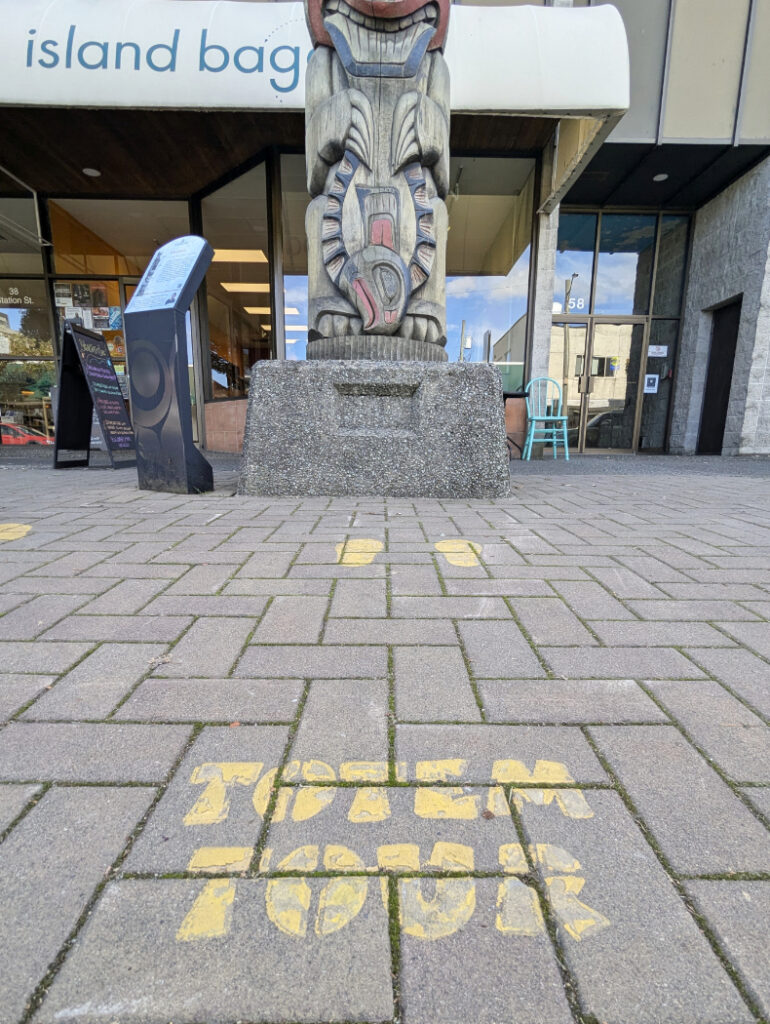
We used “totem tour” on google maps to lead us to the start. There is plenty of parking, just off Canada Avenue, next to the Cowichan Valley Museum. Once you’ve found a spot to park, look out for the yellow totem tour signs and footprints on the pavement – those show the route. The majority of the totems are in a loop along Station Street and Kenneth Street.
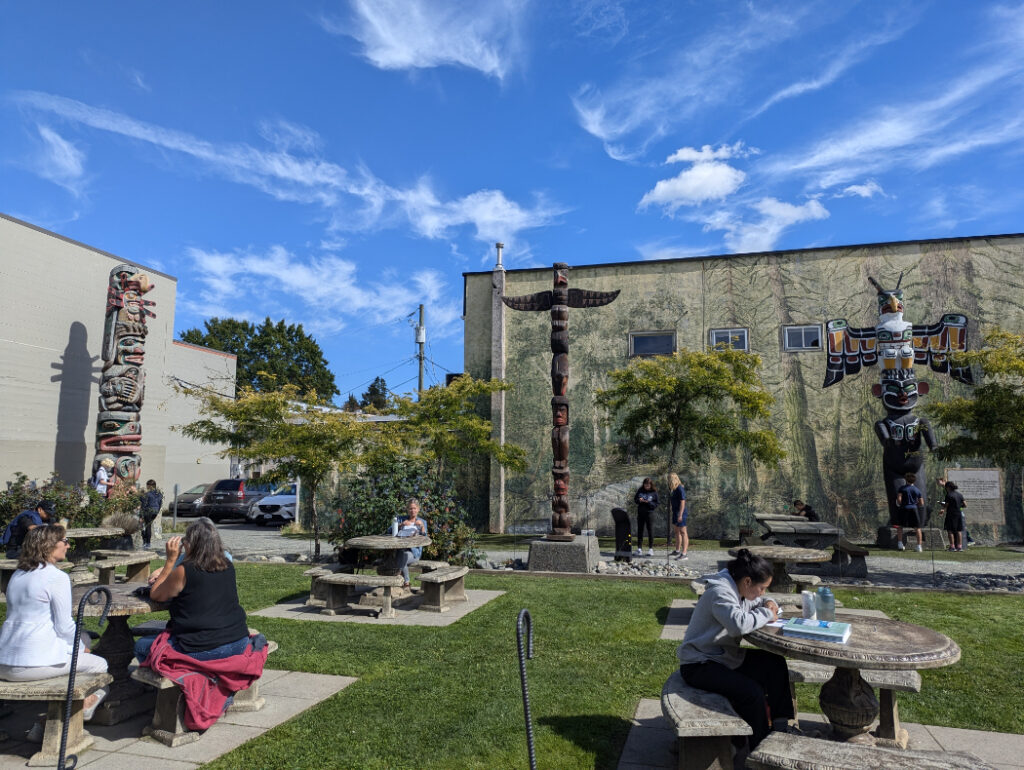
Station Street Park
There are a few locations with multiple totem poles, like Station Street Park.
Left: I really liked the Clan Totem of our Nations by Tommy Hunt Jr. (Waławidi), carving in the Kwakwaka’wakw style (2017). This totem has a salmon and a bear at the base, mother and children in the middle and a bald eagle sitting on the sun at the top.
Right: Human Between Bear’s Ears by Lenard Paquette Jackson who is Cree, from Alberta (1991). Len was a caretaker of Duncan’s totems so has helped with touch ups over the years.

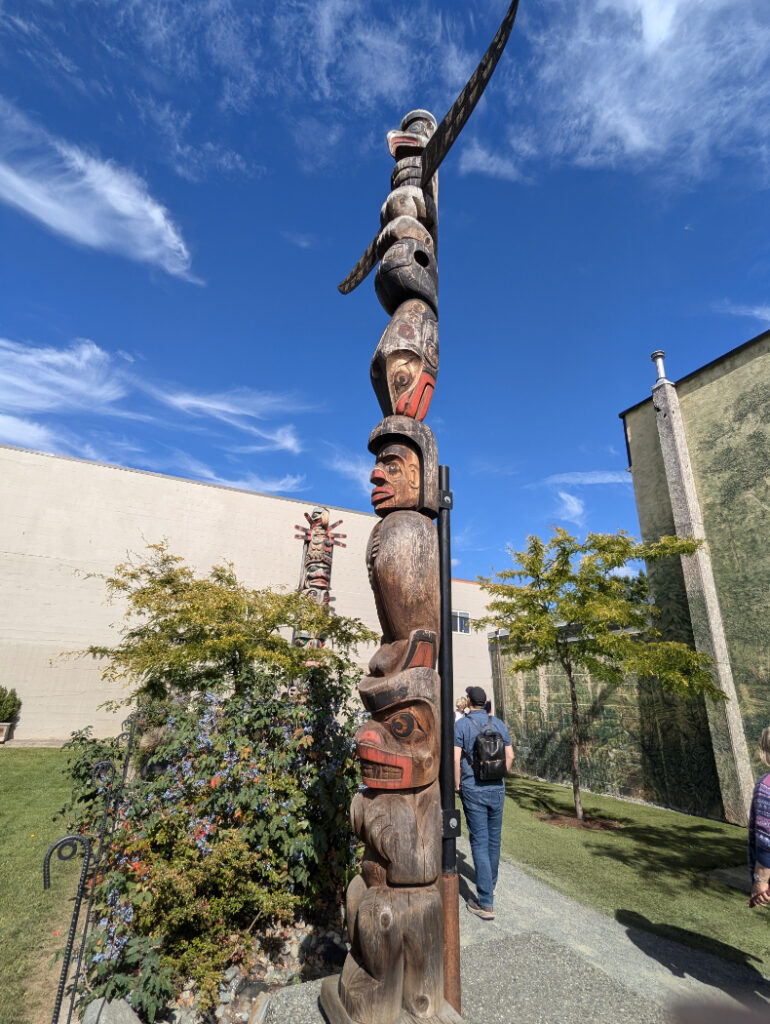
Station Street
Left: The Abolishment Pole by Si-yaaxultun (Don Smith) in 1990. This totem shows a story about a youth that terrorized the tribe until they were banished to spend time with frogs. You can see frogs coming out of the mouth of the bear.
Right: Owl Spirit by KAtēwha‡et (Tom LaFortune) from SȾAUTW̱ (Tsawout First Nation) in 1986 – this close up is of the Chief who has killer whales carved on their robes. I love the colours of these two.


Government Street
Sea and Sky by Harold Alfred in Kwakwaka’wakw style (1990). I liked the bright colours of the thunderbird and killer whale on this one. Harold Alfred is also famous for his beautiful jewelry; You can see some here, here or here.

On the far side of Government Street is Cedar Man Walking out of the Log by the renowned Kwakwaka’wakw artist Gwe-la-y-gwe-la-gya-les (Richard Hunt) in 1988. This giant work of art is the world’s widest totem pole, with a diameter of 1.8m. It is 7.6m high. The original tree was 750+ years old and was donated to the city by the forestry company MacMillan Bloedel. The design is from a Hunt family pole that honored Mungo Martin, a Kwagu’l master carver. The top was left natural to show off the gorgeous wood as part of the Cedar man’s hairline.

Left – Eagle, Raven, Bear another one by Lenard Paquette Jackson (1989). This was one of his first 3 dimensional works of art. You can see a bald eagle, a raven and a bear along with two humans.
Right – Cedar Woman and Man by Hwunu’metse (Simon Charlie) who was a master carver from the village of Kwa’mutsun (1986). This pair are wearing wearing woven Salish blankets.
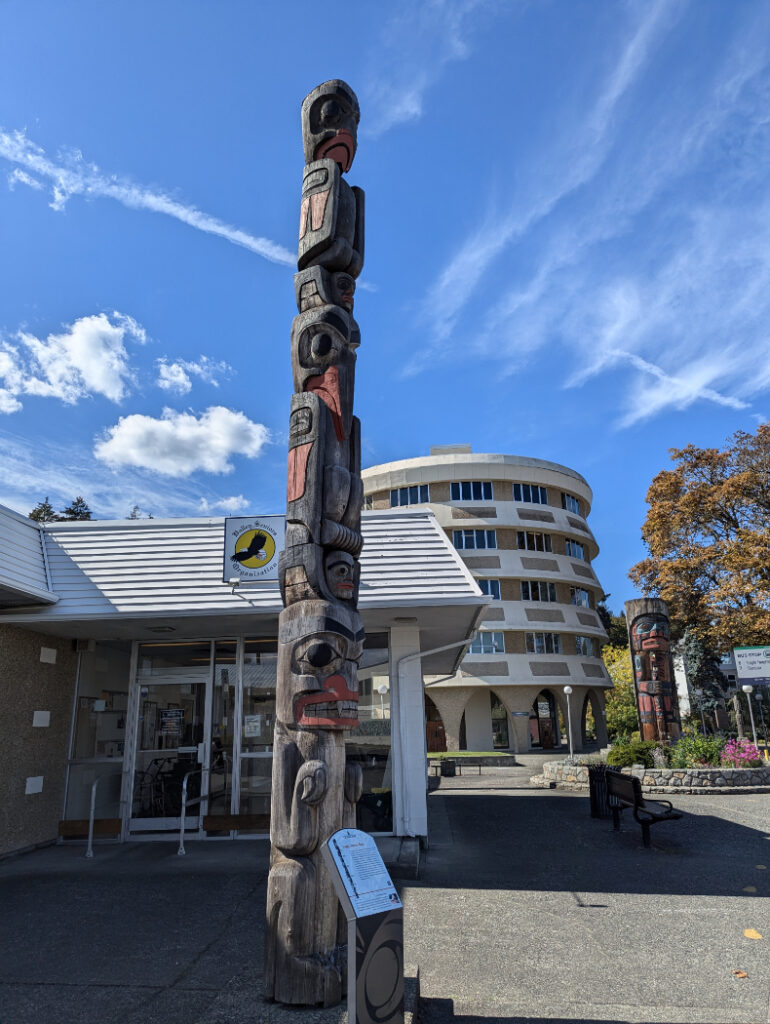
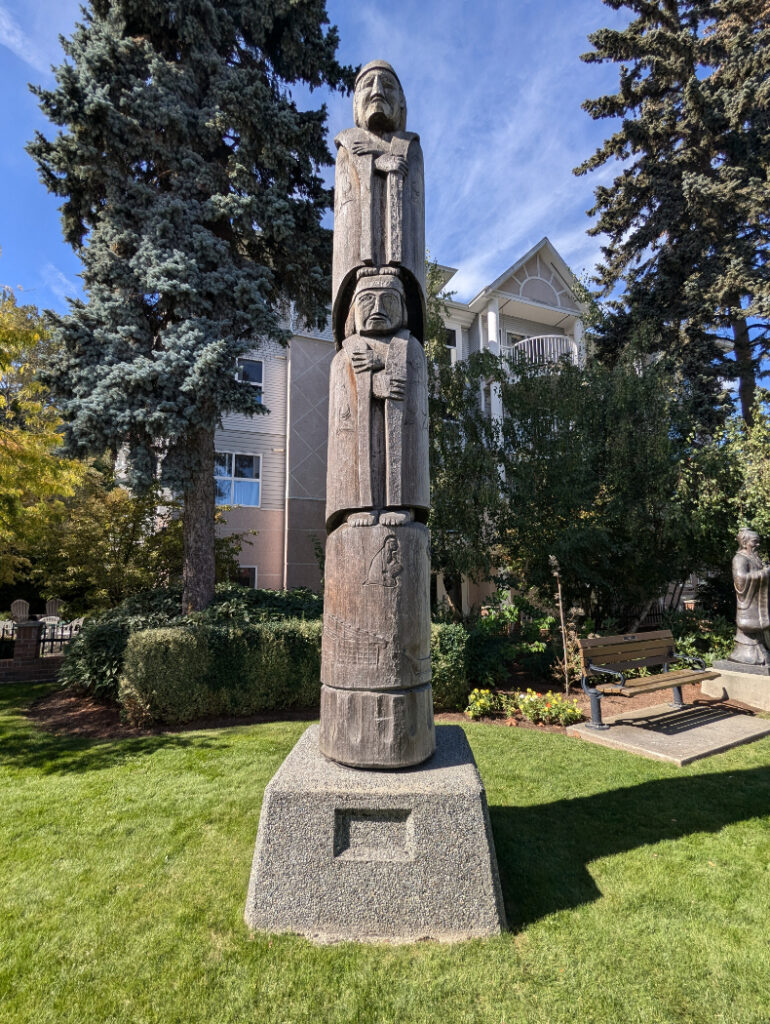
Transformation of Man by Glen Edwards, Andrew Edwards and Herb Rice in 1988. Glen and Andrew are brothers from the Penelakut Nation who taught Herb, who is from the Snuneymuxw Nation to carve. Herb recently refurbished the totem in 2019.

This is a bonus totem that was not on the map – hidden in the trees near China Gardens.

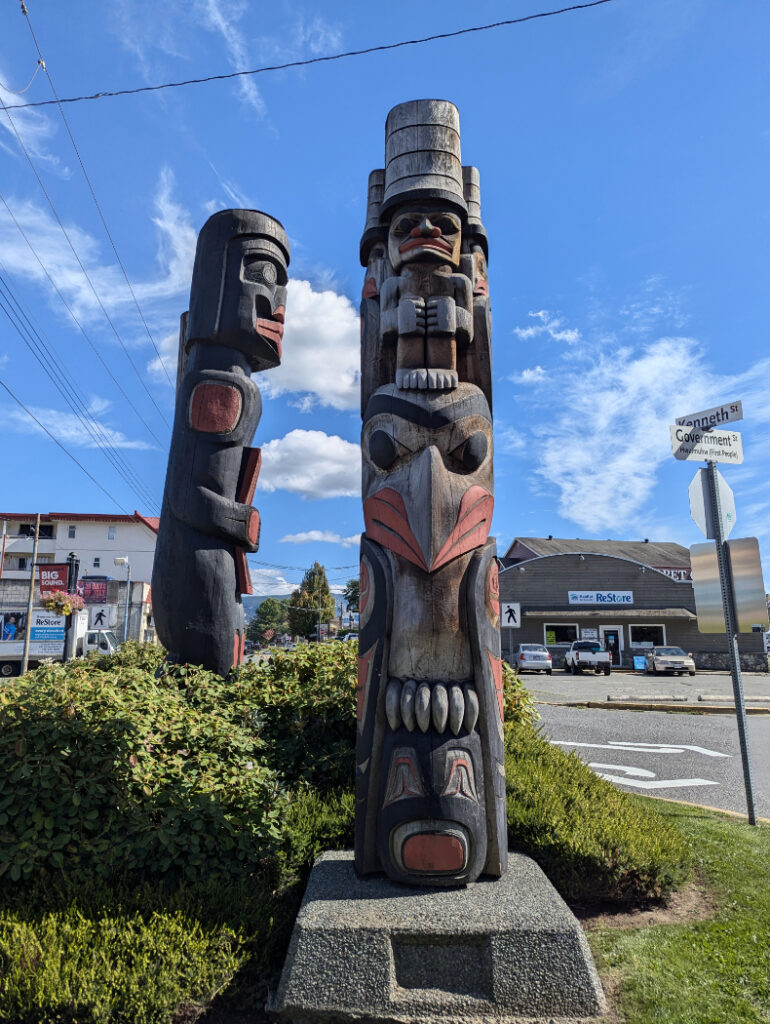
There are three totems on display where Government Street meets Kenneth Street:
- Chief’s Pole by Khut-Whee-Mul-Uhk (Francis Horne Sr.) in 1986. This pole represents the story when a killer whale was in Cowichan Bay eating all the salmon, and how the Quw’utsun people restored peace.
- Dzunuk’wa by Hokwawadi (Oscar Matilpi, who also carved one of the poles in Stanley Park) from the Ma’amtagila Band in 1989. Dzunuk’wa is a kind of wild women that acts as a greeter if someone visits when the family is away
- The Guardians also by Francis Horne Sr. in 1986. This pole was inspired by the Haida who carve three watchmen on the top of their poles that face towards the ocean.

Kenneth Street
Family Pole by Doug LaFortune (aka William Horne) in 1986, who is a Tsawout artist that grew up in Duncan. This pole has a mother bear and bear cub to reflect his family.

The Tzinquaw Story by Chief Swaletthul’t’hw (Harvey Alphonse) and Kelly Antonie both from Quw’utsun tribes in 1986. This shows the killer whale as a monster that prevented salmon from coming up the Cowichan river, until the Tzinquaw (Thunderbird) picked it up and moved it to the top of a mountain.

Our route took us back past Station Street Park. You can see Thunderbird with Dzunuk’wa, another wild woman, by Moopin’kim (Ned Matilpi,) in 1990. This is a replica of a memorial pole made by Kwakwaka’wakw master carver Hilamas (Willie Seaweed.) Ned is the son of Oscar Matilpi, who carved the other Dzunuk’wa totem, mentioned above.

More on Station Street
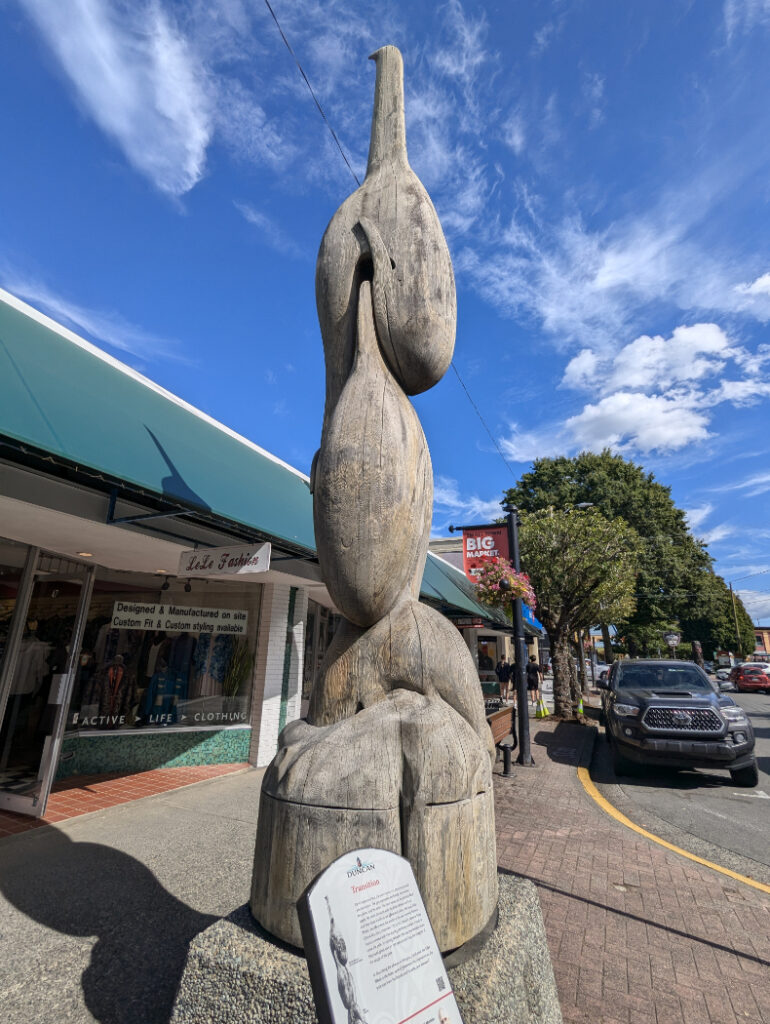
Left – Transition by David Marston who is of Algonquin and English Heritage, in 1989. The seal, killer whale and man all share the wealth of the sea – eg. salmon. I also love the artworks by his sons Luke Marston and John Marston.
Right – Bringing Light to the World by Kwantam-us (Richard Krentz) from the Shíshálh (Sechelt) Nation in 1994. This has a raven, a killer whale and a bear.

Canada Avenue
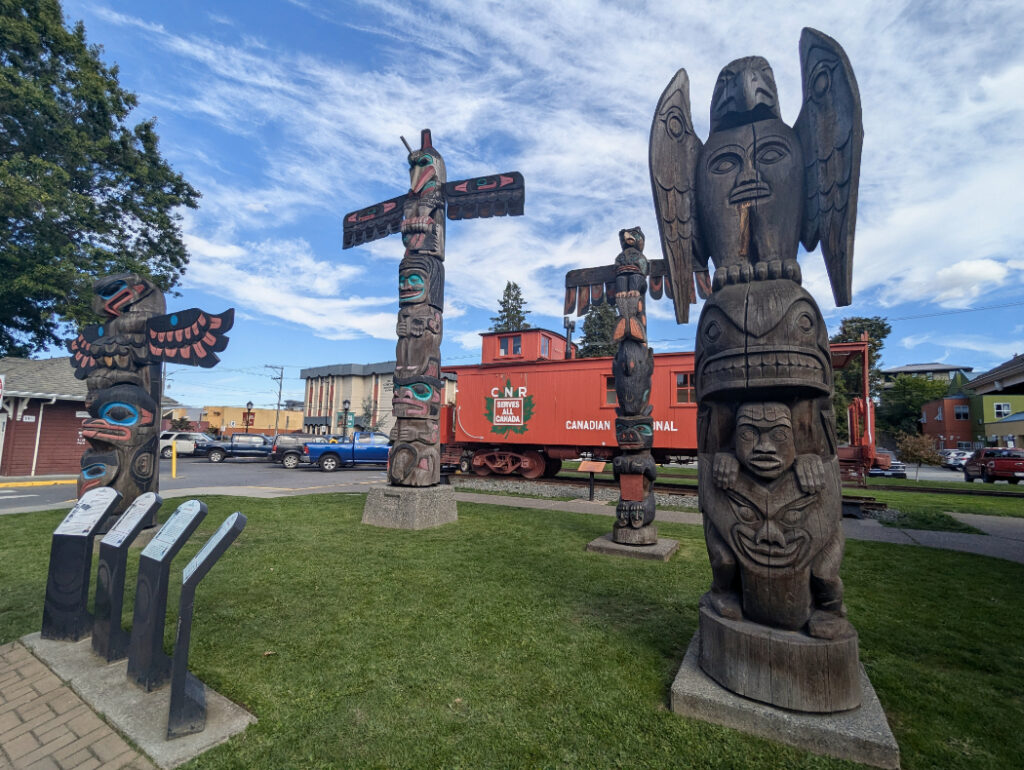
The largest number of totems are located along Canada Avenue near Charles Hoey Park and outside the Cowichan Valley Museum. Left to right, all from 1987:
- Transformation in Life by Chief Swaletthul’t’hw (Harvey Alphonse) and Nelson Canute.
- The Friendship Pole by Cicero August.
- The Owl Pole by Khut-Whee-Mul-Uhk (Francis Horne Sr.).
- Kwagu’l Bear holding a Seal by Gwe-la-y-gwe-la-gya-les (Richard Hunt).

Centennial Pole by Kwagu’l Chief Tlasutiwakis (Calvin Hunt) in 2012. The front of the pole is carved in traditional Kwakwaka’wakw style, and the back is more Coast Salish. The Quw’utsun people are represented by the story of the thunderbird and the killer whale. The chief maker at the base is to honor women in the community. The salmon on the back represent the five original tribes of the area. See more of Calvin’s totem poles here.


This is the view looking back towards the Centennial Pole. There is a really nice cafe, bookshop and galleries if you cross the road at the rainbow crosswalk.

The final four totems left to right:
- The Feast by Doug LaFortune 1987
- Raven’s Gift by Doug LaFortune 1989
- Pole of Wealth by Hwunu’metse (Simon Charlie) 1988
- Transformation by Laverne Roy “Corky” Baines 1987
The Fickle Pickle
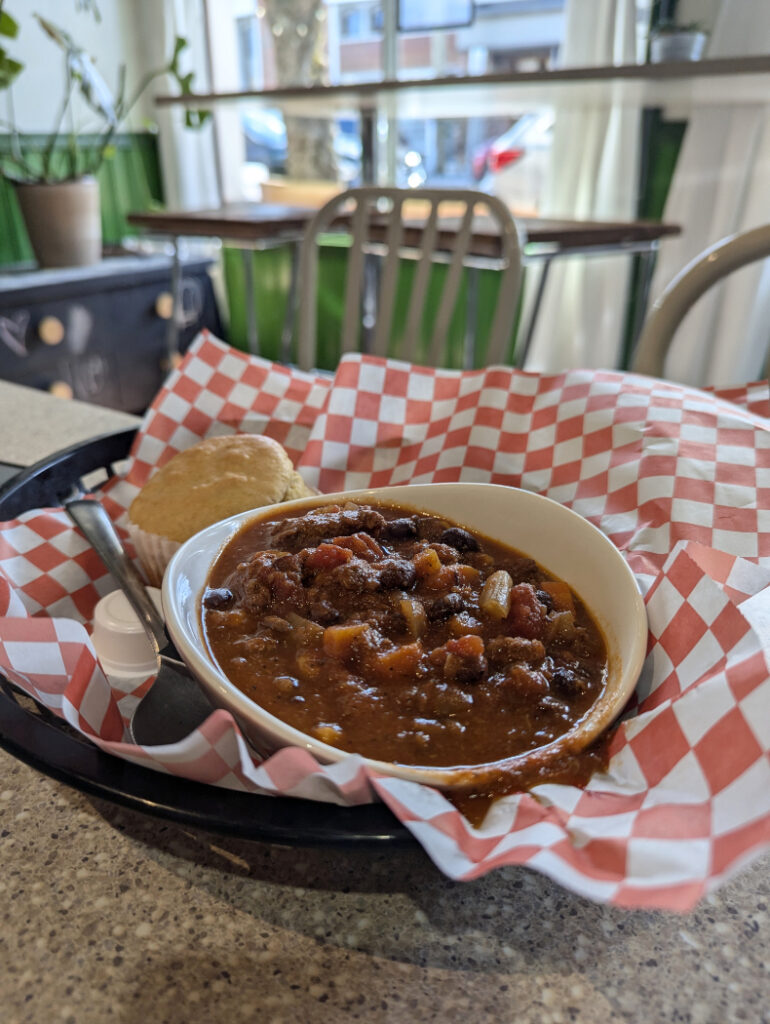
We stopped at a sweet cafe called the Fickle Pickle to grab some lunch. I had a wrap, and Marc tried the chili with cornbread. It was a fab place to eat.

Future for Duncan’s Totems
The city has actively involved local Indigenous artists in creating and maintaining the totem pole collection, fostering a sense of ownership and pride within the community. I love that this is a living, evolving collection. In the end, totems will start to disintegrate and rot and fade back into the scenery, so hopefully there will be more to come. I also appreciate that oral histories were collected from each artist, to give details about the narrative associated with each carving.

Want to learn more?
You can read more about the history of Duncan’s Totem tour, as well as about the pole raising ceremonies. If you are interested in the stories and oral histories behind each totem, you can see the whole set here. If you’re curious about the geographical locations, languages and organization of the various first nations in BC, I highly recommend this interactive map or alternatively this one. I spent time finding appropriate links for the various nations and artists mentioned above. Hopefully you’ll find them helpful.
Exploring the Totem Tour in Duncan was an absolute pleasure. My husband’s mum, Araceli, who was visiting BC at the end of the summer wanted to see a traditional totem pole – I think we did pretty well showing her this collection! Do you like the look of it? If you visit Vancouver Island, would you stop by and visit the City of Totems?

21 thoughts on “Totem Tour Trail – Duncan”
Fantastic totems and very good memories for me, I love your photos.
Yay! I hope you have good photos too – I am so glad you wanted to see totems, as we’d never been here before. 🙂
What a neat tour! First, I had no prior knowledge of Duncan so it’s great to learn more about this town. I love the totem tour and how the town has embraced it’s history and relationship with the Quw’utsun Nation. I love all of the public art initiatives towns across the world are taking up, and this one is one of the best I’ve seen.
Right? I love that it has been a long term project as well – slowly commissioning more totems over the last 40 years.
We have been to Vancouver Island many times and have never done the Totem Tour Trail in Duncan. It would be great to see the totems and learn more about the history. I love the variety in the totems. Something to plan for a return visit for sure.
I love Vancouver Island and we had a great time looking at all the totems when we visted. This is a really great informative post, makes me want to go back asap!!
Oooh do you have a post about it as well? We found loads more totems around Victoria, but Duncan was amazing for having so many so close together.
This is so cool! We recently visited Victoria and I had no idea this was so close by. Thank you for sharing.
It’s super close compared so some of the giant distances in Canada – Duncan is about an hour away from Victoria.
The totem tour sounds like a great way to learn more about the background of each of the totems. I like that this is a constantly evolving collection of totems.
So fun! Vancouver is on my lists when I have a few weeks to truly explore all of the great spots..and enjoy fun tours like this! clever idea!
Thanks Jennifer! But (just to make sure you go to the right place) this is on Vancouver Island, not in the city of Vancouver.
What a hidden gem! Saving this for when I next make it to Vancouver!
Woot woot – but please note this is on Vancouver Island, not in the city…
So cool. I had no idea there was such a tour. If I ever visit Vancouver, I’ll be sure to include this tour. I love everything about learning as a explore a new city so this would be perfect!
This is the first time I’m hearing about a totem tour. They are absolutely radiant! The sea and sky totem is so beautiful, but they’re all gems.
It’s pretty cool to see them all isn’t it 🙂
It’s incredible that Duncan has the largest outdoor collection of totem poles in the world, and the dedication to preserving the heritage and stories behind each piece is truly admirable. Your descriptions bring the totems to life, highlighting not only the beauty of each carving but also the rich cultural connections and pride of the Quw’utsun Nation and other Indigenous artists involved. This is definitely going on my must-visit list when I’m on Vancouver Island—thank you for sharing this unique experience!
This is awesome!! And I’m happy that it was in collaboration with Quw’utsun Nation – more cities need to do the same! I’d love to visit and see all of them, especially since it seems like a nice lil stroll and nothing too strenuous, maybe I’ll drive up the next time my sister visits with my nephew since he loves walks!
Thank you for sharing this wonderful glimpse into Duncan’s Totem Tour! It’s incredible to learn about the cultural significance of these totem poles and the dedication of the city to preserving and showcasing this art form. The stories behind each totem are truly fascinating, and it’s heartwarming to see the collaboration of so many talented indigenous artists. The detailed descriptions and the accessible route make it clear how meaningful and enriching this experience must be. I can imagine how inspiring it would be to walk among these majestic works of art!
How cool is this! I’m dying to visit Vancouver Island someday!